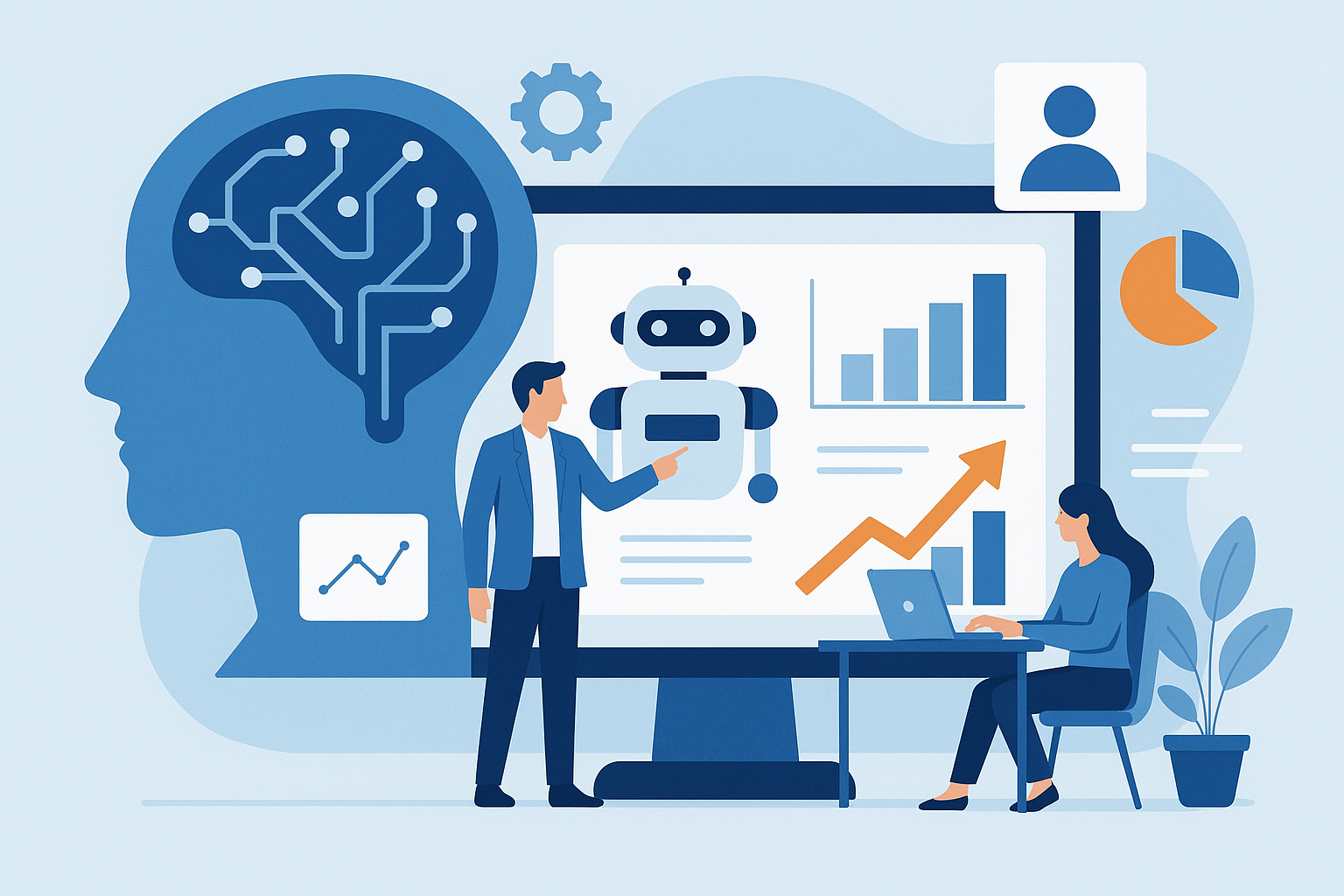
AI-Driven Strategies for Workforce Optimization and Growth
Introduction: The competitive imperative to improve your workforce
Across industries, organizations face mounting pressure to increase productivity, reduce operating costs, and adapt to market shifts. For business leaders, HR and operations managers, and mid-to-senior executives, the question is no longer whether to adopt AI, but how to apply it strategically to drive measurable workforce improvements. This article outlines actionable, AI-driven strategies for workforce optimization and growth-covering concrete use cases, a practical implementation tutorial, and long-term considerations to future-proof your organization.
Read on for a clear, step-by-step playbook you can adapt to your company’s size and maturity. The guidance emphasizes improving employee efficiency, automating routine tasks, and transforming workplace dynamics without sacrificing culture or compliance.
AI-driven use cases and benefits: 6 practical examples
Below are high-impact, realistic use cases you can pilot quickly. Each entry explains the benefit and gives a short example to illustrate application.
-
Task automation (RPA + AI)
Benefit: Reduce manual, repetitive work to free employee time for higher-value activities.
Example: Integrate AI-powered robotic process automation (RPA) to handle invoicing workflows-extracting invoice data with OCR, validating entries, and routing exceptions to finance staff for review.
-
Productivity augmentation (AI assistants)
Benefit: Enhance individual output by providing contextual recommendations and content drafting support.
Example: Deploy AI copilots for customer service agents that summarize prior interactions, suggest next-best actions, and draft response templates, reducing average handle time and improving consistency.
-
Smart scheduling and workforce planning
Benefit: Align staff allocation to demand, reduce overtime, and minimize understaffing.
Example: Use demand forecasting models to predict peak periods and automatically generate shift schedules that balance skills, preferences, and labor rules.
-
Talent analytics and predictive HR
Benefit: Improve retention and hiring quality by identifying flight risks and predicting candidate success.
Example: Apply machine learning to HRIS and engagement data to surface employees at risk of attrition and recommend targeted interventions like manager check-ins or training.
-
Skills gap detection and personalized learning
Benefit: Accelerate upskilling by delivering tailored learning paths that close strategic capability gaps.
Example: Map current employee skills to future roles using AI-driven taxonomies and automatically assign microlearning modules to close identified gaps.
-
Quality assurance and performance monitoring
Benefit: Maintain consistent output quality and provide objective feedback loops for performance improvement.
Example: Use natural language processing to analyze customer support transcripts for compliance and sentiment trends, then feed insights back into coaching programs.
Each of these use cases contributes to AI-Driven Strategies for Workforce Optimization and Growth by improving efficiency, sharpening decision-making, and enabling scalable processes.
Implementation tutorial: A 6-step practical playbook
Successful AI adoption requires disciplined execution. Use this step-by-step tutorial to design pilots that deliver measurable value and scale sustainably.
-
1. Assess needs and define outcomes
Start with a focused assessment: identify high-volume, high-cost, or high-variability processes and map current KPIs (e.g., cycle time, error rate, utilization). Define clear business outcomes-such as a 20% reduction in processing time or a 10% lift in first-contact resolution-to ensure pilots are measured against hard targets.
-
2. Select the right tools and partners
Choose tools that match your maturity and use case. For routine automation, low-code RPA with AI-enhanced OCR may be sufficient; for complex knowledge work, consider large language model-based assistants with strong data governance features. Evaluate vendors on integration capabilities, security, explainability, and total cost of ownership.
-
3. Design a small, measurable pilot
Build a limited-scope pilot with a single team or process. Define success metrics, runbooks for exceptions, and a finite timeline (8-12 weeks). Ensure datasets are clean, representative, and compliant with privacy requirements. Keep the pilot goals pragmatic: improve a specific KPI and validate user acceptance.
-
4. Execute change management and training
Pair technology with people-focused change management. Communicate the pilot’s goals and benefits clearly, involve managers early, and provide hands-on training. Use champions to drive adoption and gather frontline feedback to refine prompts, workflows, and escalation paths.
-
5. Measure, iterate, and validate impact
Track quantitative metrics (time saved, error reduction, throughput) and qualitative indicators (employee satisfaction, perceived workload). Use A/B testing where feasible to isolate AI impact. Iterate on models, prompts, and interfaces based on results and stakeholder feedback.
-
6. Scale with governance
When pilots meet targets, prepare for scale by formalizing governance: data lineage, model monitoring, access controls, and risk assessment. Standardize integration patterns and create a center of excellence to capture best practices and accelerate rollouts across teams.
Tip: Start small, measure rigorously, and prioritize employee experience-sustained adoption hinges on perceived value, not novelty.
Strategic considerations: Future-proofing, risks, and cultural impact
AI adoption for workforce optimization is as much a strategic decision as a technical one. Below are the key long-term considerations leaders must evaluate to ensure sustainable growth.
Future-proofing and strategic alignment
Embed AI within broader business strategy-connect workforce initiatives to revenue, customer experience, and product roadmaps. Prioritize capabilities that are transferable (e.g., analytics platforms, skill taxonomies) so investments remain valuable as models and tools evolve. Establish architecture patterns that decouple core systems from specific vendors to reduce lock-in risk.
Risk management and governance
Address risks proactively: data privacy, bias in decisioning, model drift, and regulatory compliance. Implement ongoing monitoring-track model performance, fairness metrics, and anomaly detection. Create clear escalation procedures when models behave unexpectedly. Strong governance protects employees and customers while keeping legal exposure in check.
Cultural and workforce impacts
AI changes roles and workflows. Transparent communication about how AI augments rather than replaces staff fosters trust. Invest in reskilling programs and career-path planning to move employees into higher-value roles created by efficiency gains. Measure employee sentiment regularly and incorporate feedback loops to refine AI behavior and tooling.
Balancing automation with human judgment
Use AI to handle scale and surface insights while retaining human oversight for nuanced decisions. For example, allow AI to flag anomalies and propose actions, but require human review for exceptions that affect customer trust or legal exposure. This hybrid approach mitigates risk and leverages both machine speed and human judgment.
Conclusion: Actionable checklist and next steps
Below is a compact playbook to convert strategy into measurable outcomes within 90-180 days.
- Checklist
- Map top 3 processes by cost/volume/variability.
- Define 2-3 pilot KPIs (time saved, error rate, NPS change).
- Choose a vendor or low-code tool aligned to use case and governance needs.
- Run an 8-12 week pilot with clear success criteria.
- Implement change management and basic reskilling for impacted staff.
- Establish monitoring: performance, fairness, and model drift metrics.
- KPIs to track
- Process cycle time reduction (%)
- Error/exception rate change (%)
- Employee productivity (tasks per FTE)
- Customer satisfaction or NPS delta
- Model performance and concept drift indicators
- Quick wins
- Automate a single high-volume admin task (e.g., invoice processing).
- Deploy AI templates for common employee queries to reduce retraining time.
- Use forecasting to improve one week of shift schedules.
- Resources
- Create a cross-functional project team (IT, HR, Ops, Legal).
- Set up a simple dashboard to report pilot KPIs weekly.
- Schedule stakeholder reviews at key milestones (launch, midpoint, post-pilot).
Consider trying this approach within a single department to validate assumptions and demonstrate ROI. With deliberate execution and people-centered change management, AI-Driven Strategies for Workforce Optimization and Growth can accelerate productivity and make your organization more competitive in a rapidly evolving market.