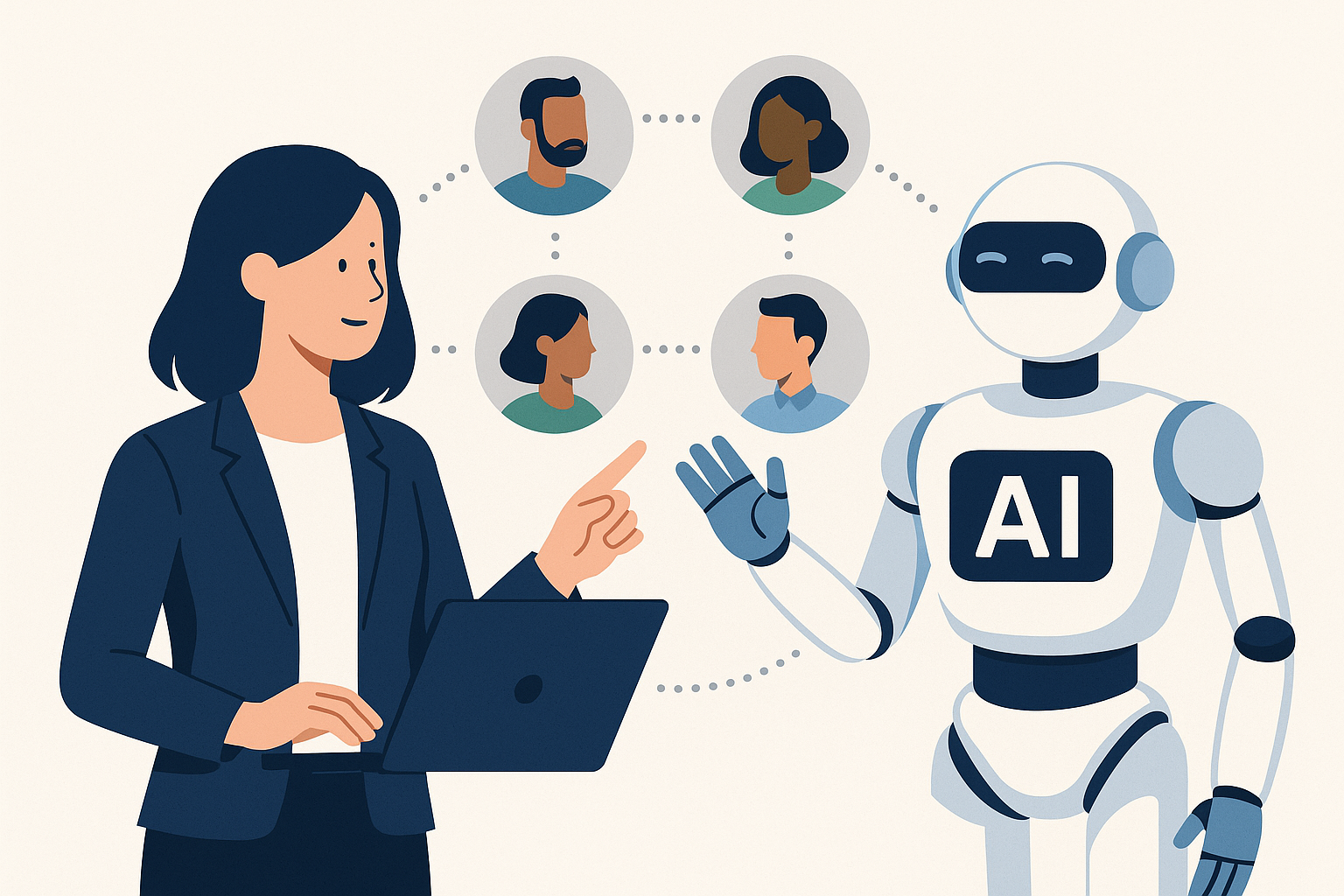
How to Use Artificial Intelligence Workforce for Companies for Outbound: A Step-by-Step Playbook
Short summary: Learn how to build an AI workforce for outbound that reduces CAC, scales personalized outreach, and increases qualified meetings. This guide covers execution steps, KPIs, common pitfalls, recent Google AI advancements, and a 30/60/90-day playbook.
Introduction - what's an "AI workforce for outbound" and why it matters
An AI workforce for outbound is a set of automated ML/LLM-powered agents, data pipelines, and human-in-the-loop processes that execute, improve, and scale outbound sales and marketing activities: prospect discovery, personalized messaging, sequence orchestration, follow-ups, and intent classification. The business value is straightforward:
- Reduced customer acquisition cost (CAC) through automation and better targeting.
- Higher outreach scale without linear headcount increases.
- More personalized, contextual messaging that improves reply and meeting conversion rates.
Below is a practical, high-intent guide on how to use artificial intelligence workforce for companies for outbound with step-by-step execution, KPIs, mistakes to avoid, and recent Google advances you can use.
Section 1 - Step-by-step execution (6 steps)
Step 1: Strategy & goal setting
Tasks:
- Define target ICPs, segments, and top use-cases.
- Set measurable goals (reply rate, meetings/week, pipeline $).
- Decide automation boundaries and SLA for human review.
Owner roles: VP Sales (goals), Head of GTM (alignment), Data Lead (metrics), Legal (compliance).
Estimated timeline: 1-2 weeks.
Sample prompt/template for goal-setting workshop:
"List 3 ICP segments with estimated TAM, ideal contact titles, and current outreach reply rates. Propose 3-month targets for meetings and expected CAC reduction."
Checklist:
- Goals documented and aligned with finance
- Priority segments chosen
- Success criteria defined
Step 2: Data readiness & enrichment
Tasks:
- Audit CRM and enrichment sources (emails, roles, firmographics, intent signals).
- Standardize schemas, deduplicate, and score leads.
- Create enrichment pipeline (email verification, firmographic append, intent enrichment).
Owner roles: Data Engineer, RevOps, Sales Ops.
Estimated timeline: 2-4 weeks.
Sample prompts/templates:
// Example enrichment rule
if (company.size == null) fetchFirmographic(company.domain);
if (email_verified == false) runEmailVerification(email);
score = intentModel.predict(recent_web_activity);
Checklist:
- CRM fields standardized
- Enrichment jobs scheduled
- Data quality KPIs in place
Step 3: Tooling & model selection
Tasks:
- Choose LLM(s) for message generation, an embeddings provider for semantic matching, and a workflow/orchestration layer (Engagement platform + orchestration).
- Select a human-in-the-loop interface and monitoring stack.
Owner roles: CTO, AI/ML Lead, Security.
Estimated timeline: 1-3 weeks (pilot stack).
Sample decision matrix:
- Model capability: multi-turn coherence, safety filters
- Latency & cost per token
- Fine-tuning / retrieval support
Checklist:
- LLM selected + testing plan
- Embedding & vector store decision
- Tooling contracts & SLAs verified
Step 4: Orchestration & workflows (human + AI roles)
Tasks:
- Define AI tasks (drafting, prioritization, A/B subject lines, intent tagging) vs human tasks (approval, closing).
- Build sequence workflows: trigger → compose → human review → send → follow-up → routing.
Owner roles: Operations Lead, Sales Managers, Product Manager.
Estimated timeline: 2-4 weeks for core flows.
Sample workflow snippet:
trigger: new high-intent lead
actions:
  - enrich lead
  - generate 3 subject lines & 2 message variants
  - run safety filter
  - assign to SDR for 1-click approve/send
Checklist:
- Workflows modeled in orchestration tool
- Human approval SLAs defined
- Escalation & fallbacks configured
Step 5: Pilot & validation
Tasks:
- Run a controlled pilot on one ICP with A/B tests vs human baseline.
- Measure reply quality, meeting conversions, and false positives.
- Collect qualitative feedback from SDRs.
Owner roles: Pilot Owner (GTM), Data Analyst, SDR Lead.
Estimated timeline: 4-8 weeks.
Sample pilot prompt:
"Draft a 3-line outreach for Head of Product at Series B fintech, addressing pricing pain and proposing a 20-min call. Tone: consultative, concise."
Checklist:
- Control cohort defined
- Success thresholds captured
- Feedback loop implemented
Step 6: Scale & continuous optimization
Tasks:
- Automate scaling: more segments, model pipelines, SLA automation.
- Set up continuous retraining & prompt tuning based on outcomes.
- Implement rollout & governance (access control, audit logs).
Owner roles: Head of Growth, ML Ops, Compliance.
Estimated timeline: Ongoing (monthly sprints).
Checklist:
- Retraining cadence set
- Model drift monitoring active
- Governance & audit in place
Section 2 - KPIs & measurement (8 metrics)
Track these KPIs to measure the effectiveness of your AI workforce for outbound:
-
Reply rate - Percent of outreach that receives any reply.
How to measure: replies / emails sent. Dashboard: sequence-level trend. Benchmark: 8-20% (varies by industry).
-
Conversion to meeting - Replies that schedule a qualified meeting.
How to measure: meetings / replies. Dashboard: funnel visualization. Benchmark: 10-30% of replies.
-
Pipeline value influenced - Total ARR/MQL value attributed to outbound motion.
How to measure: attribution model (first-touch, multi-touch). Dashboard: pipeline velocity. Benchmark: depends on deal sizes.
-
Customer Acquisition Cost (CAC) - Total cost to acquire a customer via outbound.
How to measure: (salaries + tooling + ads)/new customers from outbound. Dashboard: finance-connected KPI. Goal: downward trend vs baseline.
-
Time-to-response - Median time from lead trigger to message send.
How to measure: timestamp differences. Dashboard: SLA heatmap. Target: <24 hours for high-intent leads.
-
Intent classification accuracy - Precision/recall of automated intent tagging.
How to measure: sample-label evaluation. Dashboard: confusion matrix. Benchmark: aim for >85% precision on buy-intent class.
-
Quality score (human review) - SDR-rated helpfulness of AI drafts.
How to measure: 1-5 score captured in UI after review. Dashboard: average score by model variant.
-
Escalation rate / false positives - Percent of leads incorrectly routed or flagged.
How to measure: escalation events / total. Dashboard: incident log. Goal: minimize and investigate root causes.
Recommended dashboards: sequence funnel (sends → replies → meetings), model performance (accuracy, latency, cost), financial dashboard (CAC, pipeline). Integrate into BI tools (Looker, Tableau) or your CRM with embedded widgets.
Section 3 - Common implementation mistakes and how to avoid them
These are six frequent pitfalls when building an AI outbound workforce and how to mitigate them.
1. Poor data hygiene
Consequence: Garbage outputs, undeliverable emails, and wasted outreach. Mitigation:
- Implement strict validation & enrichment pipelines.
- Run ongoing deduplication jobs and verification services.
2. No human-in-the-loop
Consequence: Untrusted messages, brand risk, lower conversions. Mitigation:
- Require SDR approval for first 1-2 touches per account.
- Gradually increase autonomy after positive quality metrics.
3. Ignoring compliance and privacy
Consequence: Legal exposure and reputation damage. Mitigation:
- Involve Legal early; log consent and data sources.
- Apply region-specific suppression lists and opt-out handling.
4. Over-automation of sensitive outreach
Consequence: Tone-deaf messaging to executives or sensitive accounts. Mitigation:
- Flag high-value accounts for bespoke human-crafted outreach.
- Use AI only for drafts with mandatory human editing in these cases.
5. Not monitoring model drift or performance
Consequence: Falling reply quality and inaccurate intent tagging. Mitigation:
- Set retraining cadence; monitor accuracy and business KPIs.
- Maintain evaluation sets and continuous A/B tests.
6. Poor prompt and template governance
Consequence: Inconsistent brand voice and compliance risks. Mitigation:
- Centralize approved templates and maintain change logs.
- Use structured prompts with placeholders and guardrail tokens.
Section 4 - Recent AI advancements from Google and practical implications
Three Google developments relevant to building an AI workforce for outbound:
1. Advanced LLMs & multimodal models (Gemini family)
What changed: Gemini models improved contextual understanding, multi-turn coherence, and multimodal capabilities (text+images). Practical implication: better message personalization from richer context (company docs, public profiles) and improved summarization of complex product content.
Sample integration:
// pseudocode: use model to create outreach summary
context = fetchCompanyBrief(domain)
prompt = "Summarize pain points from this brief and create a 2-line outreach."
response = Gemini.generate(prompt, context)
2. Vertex AI enhancements (Studio, managed deployments, embeddings)
What changed: Vertex AI provides integrated tools for model hosting, embeddings, retrieval-augmented generation (RAG), and monitoring. Practical implication: easier deployment of custom ranking/intent models and turnkey vector search for semantic matching.
Sample integration:
- Create embeddings for company content → store in Vertex's vector store → retrieve context for prompt generation.
- Deploy intent classifier as a managed endpoint and wire into orchestration for routing.
3. PaLM API & toolkits for enterprise-grade prompts
What changed: Higher-throughput APIs, prompt tuning utilities, and safety filters. Practical implication: improved throughput for high-volume outreach and safer guardrails for outbound messages.
Sample integration:
// simplified flow
1. Enrich lead data
2. Query embeddings for account context
3. Generate message via PaLM with safety filters enabled
4. Queue for human review
Section 5 - Execution tutorial / playbook (30/60/90 day plan) + conclusion
30/60/90 day plan (mini case study)
Scenario: Mid-market SaaS company wants to reduce CAC and increase outbound meetings.
Days 0-30 (Discovery & pilot prep)
- Define ICP (mid-market fintech, ARR $5-20M).
- Audit CRM and set up enrichment pipeline.
- Select LLM + vector store; create pilot deck and success KPIs.
Days 31-60 (Pilot & iterate)
- Run 4-week pilot with 500 leads; AI drafts + SDR review.
- Measure reply rate, meeting conversion, and quality score.
- Adjust prompts, templates, and model temperature based on results.
Days 61-90 (Scale & governance)
- Automate additional segments, introduce autonomy for low-risk sequences.
- Set monitoring dashboards and tighten compliance logs.
- Begin phased rollout to full SDR team.
Quick checklist (compact)
- Define goals and ICP
- Fix CRM data & enrichment
- Pick models & orchestration tools
- Design human-in-loop workflows
- Pilot with clear success metrics
- Scale, monitor, and govern
Conclusion
Building an AI workforce for outbound transforms how companies prospect and engage. By following this step-by-step plan-covering strategy, data, tooling, orchestration, pilot validation, and scale-you can reduce CAC, increase outreach scale, and deliver more personalized messaging. Stay disciplined on KPIs, human oversight, and compliance to avoid common pitfalls. Consider how these approaches could fit your GTM motion and whether a tailored implementation plan would accelerate results for your team.
For applied expertise and hands-on implementation support, consider reaching out to atiagency.io for a tailored plan and pilot design.