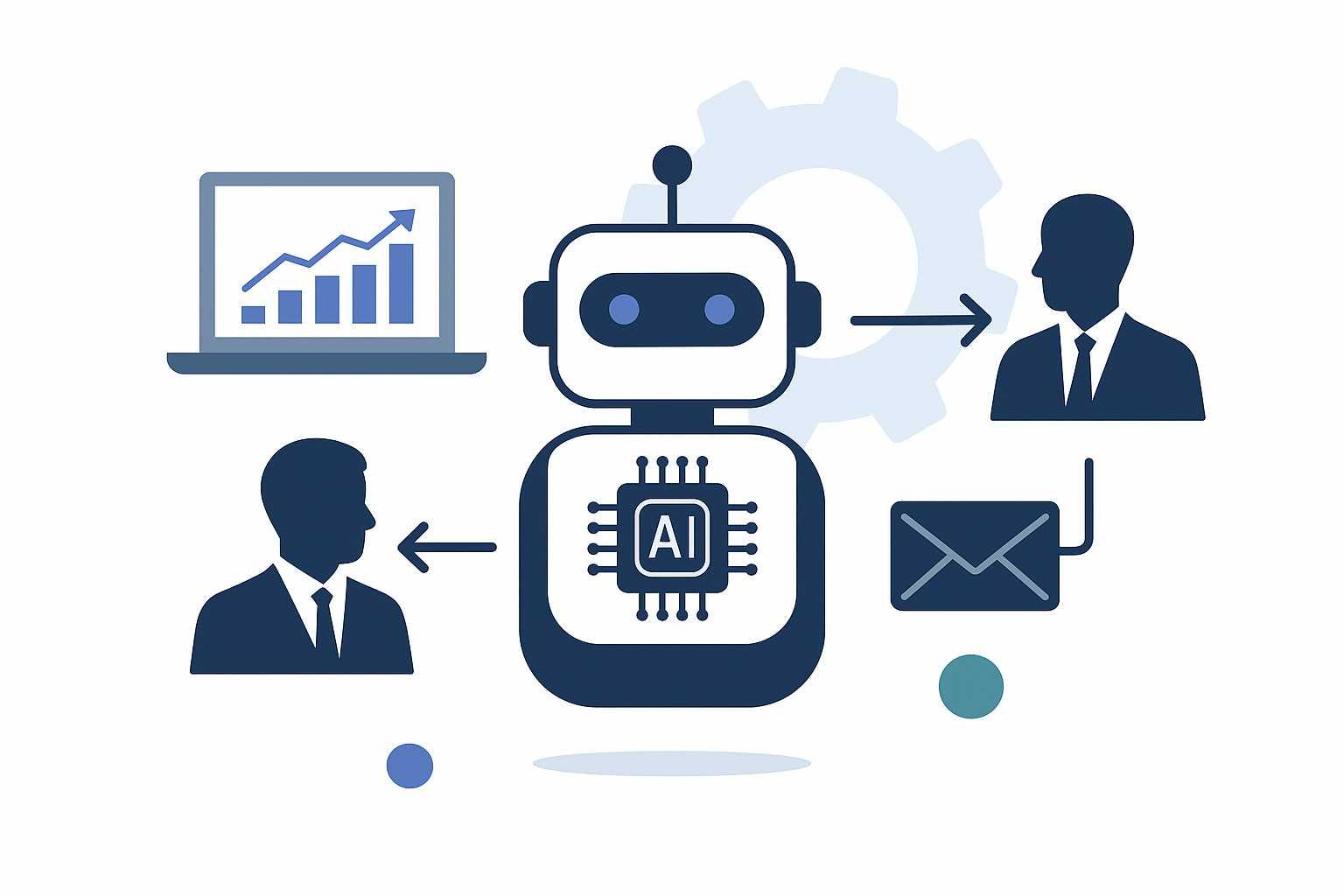
B2B AI Automation for Outbound: A Practical Playbook for Businesses
Introduction - what's outbound AI automation and why it matters
“B2B artificial intelligence automation for businesses for outbound” refers to using machine learning models and automation systems to scale and improve proactive revenue activities - prospecting, multi-channel outreach, sequencing, lead qualification, and follow-up. For B2B marketing and sales leaders, growth teams, operations managers, and technical implementers, outbound AI automation delivers three target outcomes: higher engagement rates, faster pipeline creation, and lower cost per qualified lead.
When implemented correctly, AI-driven outbound transforms manual, time-consuming tasks into data-driven workflows that personalize at scale, surface the best-fit targets, and accelerate deal velocity without sacrificing compliance or human oversight.
Background & context - Recent AI advancements that enable better outbound
Recent advances from Google and the broader AI research community have made production-grade models and tooling more accessible for enterprise outbound automation. Notable developments include:
- Large multimodal models (e.g., Google’s Gemini family) that understand context across text and other modalities, enabling richer content generation and intent detection.
- Managed model platforms (e.g., Vertex AI) that simplify deployment, monitoring, and versioning of custom and pretrained models at scale.
- Improved retrieval-augmented generation (RAG) and knowledge freshness patterns that let systems combine company-specific data with model outputs for accurate messaging and factual replies.
These improvements matter for outbound because they reduce hallucination risk, support secure private data use, and make it practical to integrate AI into CRM workflows and operational systems.
Recommended Google sources to cite:
Step-by-step execution - 8 practical steps to deploy outbound AI automation
The following numbered steps provide an actionable path from discovery to continuous improvement. Each step includes practical subtasks and tool examples.
-
Discovery & objective setting
Define business objectives and success criteria. Examples:
- Generate 150 qualified leads per quarter for the mid-market segment.
- Increase email reply rate from 3% to 9% within 90 days.
Deliverables: ROI model, stakeholder map, scope (regions, ICP, channels).
-
Data audit & preparation
Inventory and assess the quality of your data sources: CRM contacts, engagement logs, intent data, enrichment sources, and privacy/consent records.
- Cleanse duplicates and standardize company and role fields.
- Enrich firmographic and technographic signals (e.g., via Clearbit, ZoomInfo).
- Ensure opted-in consent and document lawful basis for processing.
-
Model and tool selection
Decide between hosted LLMs, managed platform models (Vertex AI, Azure OpenAI), or custom models hosted on your infrastructure.
- Use pretrained LLMs for content generation and classification; apply RAG for company-specific answers.
- Choose vendor tools for orchestration: Outreach, SalesLoft, HubSpot sequences, or account engagement platforms.
- Consider orchestration/ETL tools: Zapier, Workato, Segment, or custom Airflow pipelines.
-
Workflow design & orchestration
Design the end-to-end workflow mapping from lead sourcing to qualification to SDR handoff.
- Define triggers (e.g., intent signal, enrichment score > threshold).
- Design content pathways: cold email sequence, LinkedIn touch, follow-up cadence, and human escalation rules.
- Implement model guardrails: tone, length, personalization tokens, and suppression lists.
-
CRM & engagement tool integration
Embed AI outputs into your operational systems so actions are auditable and measurable.
- Integrate with Salesforce, HubSpot, or Dynamics to write predicted lead scores and activity logs.
- Use webhooks or middleware to push generated content to Outreach, SalesLoft, or Pardot for sequencing.
- Record provenance: which model generated the message, timestamp, and data used for generation.
-
Testing & validation
Run controlled experiments before full rollout.
- A/B test model-generated vs. human-crafted sequences on a defined sample.
- Validate factual accuracy with RAG retrieval checks and human spot reviews.
- Monitor safety metrics: hallucination rate, policy violations, and opt-out events.
-
Phased rollout
Start with a pilot group and scale by complexity:
- Pilot: one ICP segment, one outbound channel, limited volume.
- Scale: add segments, channels (dialer, LinkedIn), and more complex qualification logic.
- Governance: approve templates and maintain a suppression list to avoid overcontacting.
-
Continuous monitoring and improvement
Establish a feedback loop between SDRs, data teams, and model owners.
- Log model outputs and human edits to retrain or fine-tune models.
- Automate retraining cadence based on label volume and distribution drift.
- Maintain a playbook for when to revert model-generated messaging (e.g., regulatory changes).
For managed service or implementation support, consider reviewing professional service offerings such as atiagency.io services to augment internal capabilities.
KPIs & measurement - 6 metrics to track and how to benchmark them
Track a balanced set of performance and model-quality KPIs to measure both business impact and system reliability.
-
Email reply rate - Replies / Emails delivered.
How to track: Use sequence tool metrics. Benchmark: B2B cold email reply rates typically range 2-10%; aim for a 2-3x improvement from baseline with strong personalization.
-
Qualified leads generated - Number of MQLs/SQLs that meet qualification criteria per period.
How to track: CRM lead status updates and qualification callbacks. Benchmark: tie to historical SDR productivity and campaign volume; measure lift vs. control cohorts.
-
Conversion rate (lead → opportunity) - Opportunities / Qualified leads.
How to track: CRM opportunity creation. Benchmark: varies by vertical; measure delta between AI-assisted and non-AI channels.
-
Pipeline acceleration - Reduction in days from first contact to opportunity.
How to track: Compare time-to-opportunity metrics pre- and post-automation. Benchmark: 10-30% acceleration is a reasonable early target.
-
Cost per lead (CPL) - Total campaign spend / Qualified leads.
How to track: Include platform costs, model inference costs, and human review time. Benchmark: target moving CPL downward while maintaining lead quality.
-
Model accuracy & safety metrics - Classification accuracy, false positive rate, hallucination incidents, and opt-out rates.
How to track: Create labeled test sets, monitor drift, and log safety incidents. Benchmark: maintain false positive rates within acceptable thresholds defined by business risk tolerance.
Set dashboards in your BI tool (Looker, Tableau, or Salesforce Reports) and define alert thresholds for regressions.
Common implementation mistakes to avoid (and how to mitigate them)
Here are frequent pitfalls and prescriptive mitigations to ensure durable outcomes.
-
Poor data quality
Problem: Dirty or inconsistent CRM and enrichment data produces irrelevant outreach.
Mitigation: Run an initial data cleanse, enforce validation rules on ingestion, and schedule monthly enrichment refreshes.
-
Ignoring privacy and compliance
Problem: Non-compliant messaging or improper data processing risks fines and reputational damage.
Mitigation: Map lawful bases for data processing (GDPR/CCPA), implement suppression and consent flags, and keep audit logs for model decisions.
-
Overreliance on automation
Problem: Fully automated outreach can feel robotic and alienate high-value accounts.
Mitigation: Use AI to augment humans. Require human review for high-value accounts and include manual personalization steps for enterprise targets.
-
Insufficient testing and control groups
Problem: Rolling out without experiments prevents causal measurement of impact.
Mitigation: Implement A/B tests and holdout controls, measure uplift statistically, and iterate only on validated improvements.
-
Weak feedback loops
Problem: No mechanism to capture human edits, opt-outs, and closed-loop sales outcomes, so models degrade.
Mitigation: Instrument edit logs, label outcomes, and build retraining pipelines that incorporate human corrections.
-
Unclear ownership and governance
Problem: Confusion over who owns templates, model versions, and escalation creates process gaps.
Mitigation: Define RACI for model maintenance, template approval, and incident response. Assign a model owner and an operations lead.
-
Neglecting measurement of downstream effects
Problem: Focusing only on reply rates and not on pipeline quality leads to false positives.
Mitigation: Connect outreach outputs to revenue and close rates; prioritize high-quality pipeline growth over vanity metrics.
Practical example & mini case study - sample outbound workflow and expected impact
Example: Mid-market SaaS company targeting VP Engineering at 500-1,000 employee companies.
Workflow (sequence)
- Trigger: Intent alert from Bombora + enrichment indicates “uses AWS + Kubernetes”.
- Model step: Retrieve Account Brief (RAG) from internal CMS and generate a three-touch email sequence personalized to tech stack and org size.
- Human review: SDR reviews and tweaks subject line for top-20 accounts; others proceed automatically.
- Channel mix: Email day 0, LinkedIn touch day 3, phone attempt day 7, nurture if no response.
- Qualification: Automated scoring (predictive lead score > 0.7) triggers an SDR task for discovery call.
Expected impact (hypothetical)
- Baseline cold email reply rate: 2.5% → After implementation: 8% (3x improvement).
- Qualified leads per month: 30 → 90.
- Time-to-opportunity reduced by 25%.
- CPL reduced by 35% after automation and improved targeting.
These numbers illustrate a realistic uplift when personalization, intent signals, and RAG are combined with proper governance. Actual results will vary by industry, product-market fit, and data quality.
Implementation checklist, tools, timeline & next steps
Printable checklist
- Define objectives, ICP, and success metrics
- Complete CRM and enrichment data audit
- Choose model approach (pretrained vs. custom) and vendor
- Design workflow & guardrails (suppression lists, opt-outs)
- Integrate with CRM and sequencing tool
- Run pilot with A/B tests and holdouts
- Establish monitoring dashboards and retraining cadence
- Assign model owner and governance RACI
- Scale in phases and document lessons learned
Recommended tools
- Model & platform: Google Vertex AI, Azure OpenAI, or managed LLM APIs
- CRM: Salesforce, HubSpot, Microsoft Dynamics
- Engagement: Outreach, SalesLoft, HubSpot Sequences
- Orchestration/ETL: Workato, Zapier, Segment, Apache Airflow
- Enrichment/intent: Clearbit, ZoomInfo, Bombora
- BI & monitoring: Looker, Tableau, Datadog for infra metrics
Quick timeline (typical)
- Weeks 0-2: Discovery, objectives, and data audit
- Weeks 3-6: Integration & pilot model configuration
- Weeks 7-10: Pilot testing, A/B experiments, and validation
- Weeks 11-16: Phased rollout and monitoring
- Ongoing: Continuous improvement and retraining
Next step: Consider engaging internal teams and external partners to accelerate execution and governance. Contact atiagency.io to discuss tailored implementation support and professional services.
Conclusion
Deploying B2B artificial intelligence automation for businesses for outbound offers measurable gains in engagement, lead quality, and pipeline velocity when done with disciplined data practices, model governance, and human-in-the-loop controls. Follow a structured rollout: define objectives, clean and enrich data, select the right models and tools, integrate with your CRM, test thoroughly, and maintain feedback loops. With clear KPIs and avoidance of common pitfalls, AI-powered outbound becomes a repeatable, revenue-driving capability.
Alt text suggestions for images: “Flowchart of AI-enabled outbound workflow integrating CRM and sequence platform”; “Dashboard example showing email reply rate and qualified leads over time”; “Checklist graphic for AI outbound implementation.”