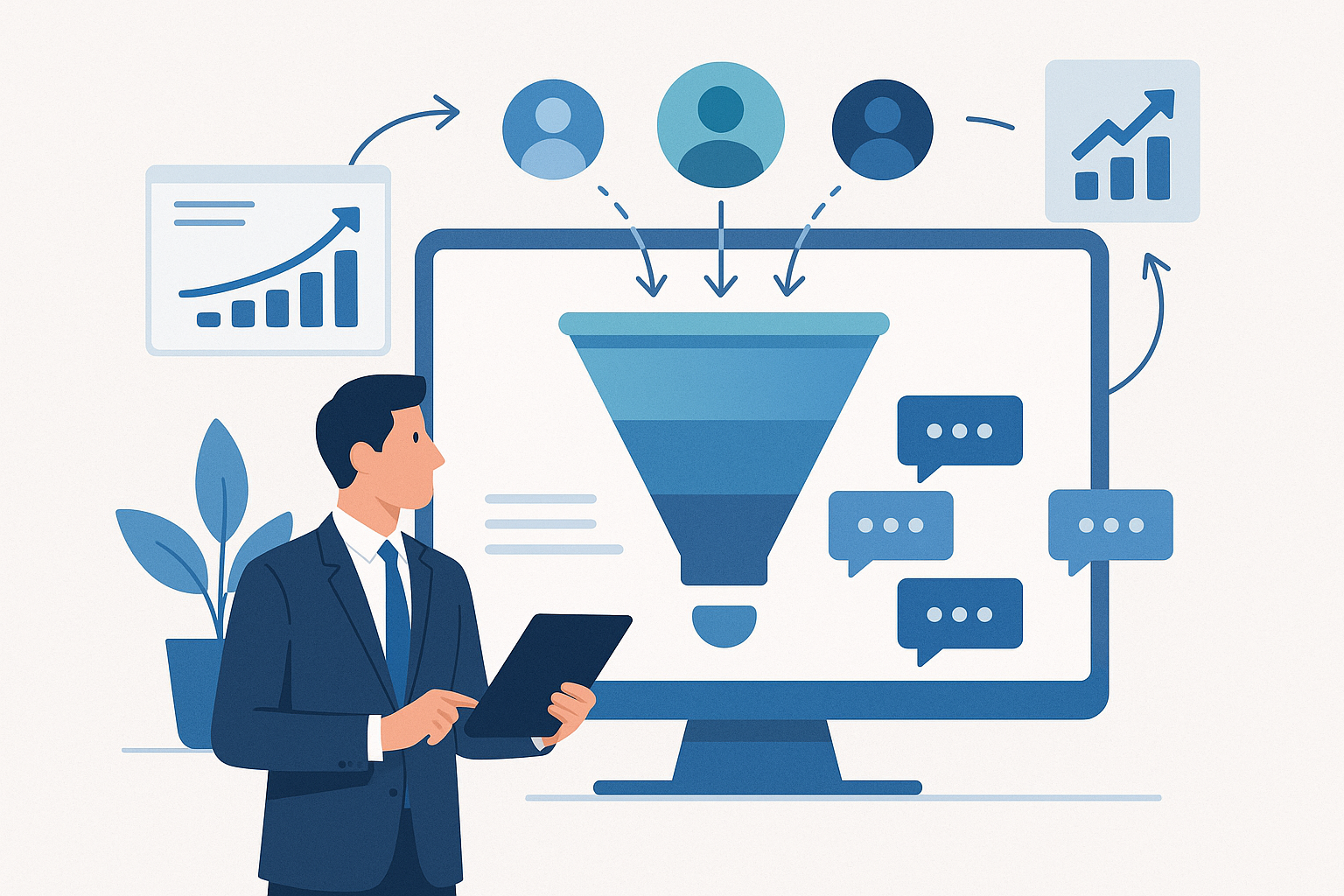
How to Use Automated Client Acquisition Funnels for Startups - A Practical Playbook
Introduction: Fixing inefficient manual client acquisition with automation
Early-stage startups frequently waste time on manual outreach, inconsistent follow-up, and fractured attribution. The solution is a reproducible, measurable approach to how to use automated client acquisition funnels for startups: automated capture, qualification, nurture, conversion, and onboarding that scale with predictable KPIs. This guide shows founders, growth marketers, and product teams how to implement a full funnel-step-by-step-with tools, example workflows, KPIs, and troubleshooting tips.
Step-by-step execution: 7 stages to build an automated client acquisition funnel
Below are seven clear stages to design and deploy an automated acquisition funnel that converts leads into paying customers.
-
1. Define ICP and craft your core offer
Identify your Ideal Customer Profile (ICP) and the offer that solves a specific pain. For startups this means:
- Segment by company size, ARR, role, or vertical.
- Articulate a simple value proposition and a low-friction entry offer (trial, audit, template, demo).
- Define the desired action (lead magnet download, demo request, trial signup).
-
2. Map funnel stages and success criteria
Define stages (Awareness → Interest → Consideration → Intent → Conversion → Onboarding) and set conversion goals for each. Example metrics:
- Landing page visitor → lead: target 2-6%
- MQL → SQL: target 20-40%
- SQL → Paid customer: target 10-30%
-
3. Set up lead capture and tracking
Implement tracked entry points: landing pages, paid ads, organic forms, chatbots, and content CTAs. Essentials:
- Single-source-of-truth contact capture (CRM like HubSpot, Pipedrive, or Salesforce).
- UTM and click ID tagging for attribution.
- Server-side tracking or enhanced conversions for reliable analytics.
-
4. Automate nurturing and personalization
Use automated sequences that combine email, SMS, in-app messages, and retargeting. Personalize based on ICP and behavior:
- Behavioral triggers: visited pricing page, returned 3x, used calculator.
- Content sequences for different funnel stages (educational → comparison → demo invite).
-
5. Scoring and qualification
Implement lead scoring (behavior + firmographic) and automatically route high-score leads to sales or trigger a demo scheduler. Use automated enrichment (Clearbit/ZoomInfo) to reduce manual research.
-
6. Conversion and onboarding automation
Automate purchase links, contract signing, billing, and first-run onboarding flows (product tours, setup checklists, kickoff emails). Reduce time-to-first-value with templated welcome flows and in-product guidance.
-
7. Iterate, measure, and scale
Continuously instrument experiments, measure funnel drop-offs, and improve. Run A/B tests for messaging, landing pages, and nurture timings before increasing spend.
Tutorial-style walk-through: tools, integrations, and example workflows
This practical section shows specific tools and integrations to implement each stage and includes short webhook and Zapier/Make examples.
Recommended tech stack (early-stage friendly)
- Landing pages + forms: Webflow, Unbounce, or Carrd
- CRM: HubSpot CRM (free tier), Pipedrive, or Close
- Marketing automation: HubSpot Workflows, ActiveCampaign, or Customer.io
- Ad & analytics: Google Ads, GA4, and a server-side event collector
- Enrichment & intent: Clearbit, Apollo, or 6sense
- Scheduling: Calendly or SavvyCal
- Orchestration: Zapier or Make (Integromat) for lightweight automation
- Advanced ML/personalization: Vertex AI (Google) or open-source models
Example workflow: Visitor → Demo (using Zapier)
- User fills demo form on Webflow. Form posts to Webflow CMS.
- Zapier triggers on new Webflow form submission.
- Zapier action: enrich contact via Clearbit API.
- Zapier action: create/update contact in HubSpot CRM.
- If score > threshold, Zapier sends Slack alert to sales and auto-sends Calendly invite.
Zapier example (mapping)
- Trigger: New Webflow Form Submission
- Action 1: Webhook - GET https://person.clearbit.com/v2/people/find?email={{email}}
- Action 2: HubSpot - Create or Update Contact (map fields from Clearbit)
- Action 3: Filter - Only continue if company_size > 50 and role contains "Head" OR score > 50
- Action 4: Slack - Notify Sales
Short webhook code snippet (Node.js) - handle demo form and push to CRM
const express = require('express');
const fetch = require('node-fetch');
const app = express();
app.use(express.json());
app.post('/webhook/demo', async (req, res) => {
  const { name, email, company } = req.body;
  // Enrich via Clearbit (example)
  const clearbitRes = await fetch(`https://person.clearbit.com/v2/people/find?email=${email}`, {
    headers: { Authorization: `Bearer ${process.env.CLEARBIT_KEY}` }
  });
  const clearbit = await clearbitRes.json();
  // Push to HubSpot
  await fetch('https://api.hubapi.com/contacts/v1/contact', {
    method: 'POST',
    headers: { 'Content-Type': 'application/json', 'Authorization': `Bearer ${process.env.HUBSPOT_KEY}` },
    body: JSON.stringify({ properties: [{ property: 'email', value: email }, { property: 'company', value: company }] })
  });
  res.status(200).send('ok');
});
app.listen(3000);
Make (Integromat) scenario idea
Use Make to transform data, enrich contact information, and perform conditional routing to multiple CRMs or ad platforms in a single scenario. Ideal for startups with complex routing rules or multi-touch attribution needs.
Tip: Start with one streamlined workflow and instrument everything. Complexity can be added after you validate the core conversion steps.
KPIs to track (and suggested benchmarks)
To know how effective your automated funnel is, track these core KPIs. Benchmarks vary by vertical; the suggested targets below are realistic starting goals for early-stage SaaS and service startups.
- Customer Acquisition Cost (CAC) - Total marketing + sales spend divided by new customers. Suggested target: aim for CAC payback < 12 months for SaaS; for high-ticket services, calculate on deal size and margin.
- Lifetime Value (LTV) - Average revenue per customer over expected lifecycle. Target LTV:CAC ratio > 3:1 as a long-term goal.
- MQL → SQL conversion rate - Measures quality of leads. Suggested benchmark: 20-40% (early-stage target: 15-25% initially).
- Funnel conversion rates - Visitor → Lead, Lead → Demo, Demo → Paid. Example starting targets: Visitor→Lead 1-5%, Lead→Demo 10-25%, Demo→Paid 10-30%.
- Time-to-first-revenue - Days from first touch to paid conversion. Lower is better; target < 60 days for most B2B SaaS trials.
- Activation / Time-to-Value - % of users hitting first key milestone in first 7-30 days.
- Attribution accuracy - % of conversions with reliable source attribution. Aim to increase server-side tracked conversions to reduce lost signals.
How to measure: centralize events in your CRM and analytics (GA4 + server-side collector + CRM-based revenue reconciliation). Regularly export cohort data and run funnel analysis weekly.
Common implementation mistakes and corrective actions
These frequent errors derail funnels. Correct them early.
-
Poorly defined ICP
Symptom: High lead volume, low conversion. Fix: Revisit customer interviews, segment customers by value, and update ad targeting and scoring to prioritize high-value ICPs.
-
Over-automation (losing human touch)
Symptom: Diminished demo-to-close conversion. Fix: Insert manual review steps for high-value leads, add personalized outreach templates, and route VIPs to SDRs immediately.
-
Bad data and weak attribution
Symptom: Misleading ROI calculations. Fix: Implement server-side tracking, normalize UTM parameters, and reconcile CRM revenue with analytics weekly.
-
Ignoring onboarding
Symptom: High churn after conversion. Fix: Automate onboarding flows and measure activation events; assign a customer success touch for first 30 days.
-
Not A/B testing
Symptom: Stagnant conversion rates. Fix: Run structured A/B tests (landing pages, CTAs, email sequences) and only scale winners with statistical significance.
What’s new: recent Google AI advances and how startups can use them
Google's AI developments offer practical improvements to automated client acquisition funnels:
Vertex AI for model-driven personalization
Vertex AI makes it accessible to train and deploy models that personalize messaging and ranking. Startups can use Vertex to predict lead-to-customer probability and personalize content at scale.
Generative personalization
Generative models can produce tailored email sequences, landing page copy variants, and proposal drafts. Use with guardrails: template-based prompts, cohort-level testing, and human review for sensitive communications.
Improved attribution and analytics
Google’s evolving measurement techniques (enhanced conversions, improved cross-device signals) reduce lost conversions. Combine GA4 server-side tagging with CRM revenue reconciliation for better CAC estimates.
How to apply these advances:
- Use Vertex AI to create a lead scoring model that updates in real time and feeds your CRM for routing.
- Generate personalized email sequences with templated prompts and A/B test variations automatically.
- Implement server-side event collection to minimize tracked event loss and improve ad spend optimization.
Actionable checklist, troubleshooting tips, and a mini case example
Actionable implementation checklist
- Define ICP and one clear entry offer.
- Build a tracked landing page with UTM templates.
- Connect form → enrichment → CRM via webhook or Zapier/Make.
- Create 3 automated nurture streams (cold, engaged, demoed).
- Implement lead scoring and routing rules.
- Set up onboarding automation and activation tracking.
- Instrument KPIs and schedule weekly funnel reviews.
Troubleshooting tips
- If lead quality drops after a campaign, pause the campaign, review audience targeting, and check enrichment accuracy.
- If conversions aren’t tracking, verify server-side events, UTM consistency, and CRM webhooks.
- If nurture emails have low engagement, check deliverability (SPF/DKIM/DMARC) and refresh subject lines and personalization.
- If onboarding completion is low, map the first 7 days and remove friction from the initial setup steps.
Mini case (hypothetical): "ClearOps" - from 10 to 40 customers in 6 months
ClearOps, a B2B operations SaaS startup, implemented an automated funnel:
- Built a single high-converting landing page with a product ROI calculator.
- Used a Zapier workflow: Form → Clearbit enrichment → HubSpot → conditional Calendly invite.
- Deployed a Vertex AI lead-scoring model predicting demo-to-close probability and routed high-probability leads to sales.
- Result: Demo-to-paid conversion rose from 12% → 24%, CAC decreased 30%, and time-to-first-revenue dropped from 45 to 22 days.
Conclusion and next steps
Automating client acquisition funnels transforms inconsistent outreach into a repeatable growth machine. Follow the 7-stage playbook: define ICP, map stages, capture leads, automate nurture, score & qualify, automate conversion & onboarding, then iterate and scale. Track the KPIs listed here, avoid the common mistakes, and use modern AI tools like Vertex AI for predictive scoring and generative personalization.
Consider engaging atiagency.io to audit your funnel, implement the automation, or run a performance experiment tailored to your ICP. For more learning, explore our articles and resources on the site or schedule an internal review using your current funnel data.