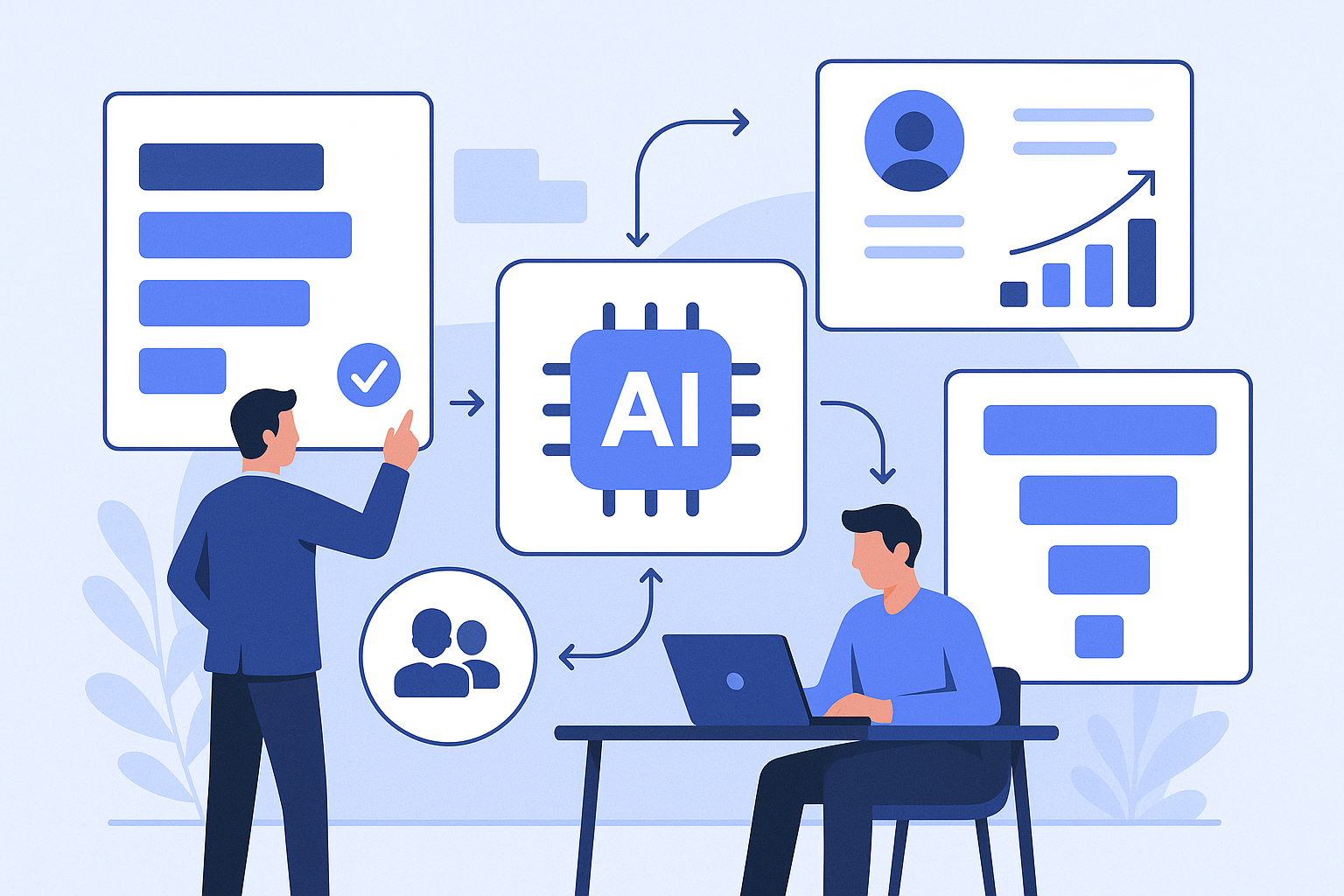
Best B2B Pipeline Generation with Artificial Intelligence for Sales Teams
Artificial intelligence is reshaping how B2B sales teams source, prioritize, and convert pipeline. This guide explains what best B2B pipeline generation with artificial intelligence for sales teams looks like in practice, why it's a high-intent initiative for revenue leaders, and how to execute, measure, and avoid common pitfalls.
1. Why AI-driven B2B Pipeline Generation Matters (and Recent AI Advances)
AI-driven B2B pipeline generation uses machine learning and generative capabilities to identify high-value prospects, score intent, personalize outreach, and accelerate qualification. For sales leaders, this is high-intent because it directly impacts pipeline quality, conversion rates, and cost efficiency across the funnel.
Recent AI developments that make this possible
- Large language models (LLMs) and multimodal models: Google’s Gemini family and PaLM advances improved contextual understanding and intent detection, enabling better lead enrichment and personalized sales messaging.
- MLOps and managed model services: Google Cloud Vertex AI simplifies model training, deployment, and monitoring-reducing time-to-production for predictive lead scoring and recommendation systems.
- Search and intent insights: Google’s Search Generative Experience (SGE) and enhancements in semantic search improve intent signals for demand-gen and content optimization.
- Workspace/assistant integrations: Google Duet AI and conversational assistants make automated outreach, meeting summarization, and sales playbook execution more efficient.
These advancements reduce friction between experimentation and deployment, making practical AI-infused pipeline generation achievable for B2B teams of all sizes.
2. Step-by-step Execution: From Data to Rollout
Implementing the best B2B pipeline generation with artificial intelligence for sales teams requires a deliberate, staged plan. Below is an actionable roadmap you can follow.
-
Define objectives and KPIs
Start by aligning stakeholders on target outcomes (e.g., increase SQLs, shorten sales cycle, reduce CAC). Map these to measurable KPIs.
-
Inventory and prepare data
Gather CRM records, marketing engagement, web analytics, intent/third-party signals, account firmographics, and enrichment data. Tasks:
- Clean duplicates and normalize fields (company names, job titles, emails).
- Timestamp events consistently for funnel and velocity metrics.
- Create a unified customer identifier across systems.
- Document data lineage and permissions for privacy compliance (GDPR/CCPA).
-
Select model types and tools
Choose between predictive models (lead scoring, propensity-to-buy), generative models (personalized outreach, content), or hybrid systems.
- Predictive: Gradient-boosted trees or logistic models for explainability and precision.
- ML + LLM hybrid: Use ML for scoring and LLMs for context-aware messaging and enrichment.
- Platforms: Consider Vertex AI, AWS SageMaker, or Azure ML for MLOps; integrate LLMs via hosted APIs where appropriate.
-
Feature engineering and training
Build features from historical behavior (email opens, page visits), firmographics (industry, ARR band), and intent signals.
- Create time-decay features for recent engagement.
- Encode account-level and contact-level signals separately for ABM logic.
- Use stratified validation to prevent leakage (time-based splits are essential).
-
Validate and test
Run offline validation (precision, recall, AUC) and simulate impact on pipeline using backtests. Then run live A/B tests or canary deployments.
- Test against holdout accounts to measure true uplift.
- Use controlled rollouts to limit risk (e.g., 10% of SDRs).
-
Integration with sales systems and workflows
Integrate scoring, recommendations, and outreach templates into CRM, sales engagement platforms, and playbooks.
- Embed model output into record views (Salesforce, HubSpot).
- Automate task creation for high-priority accounts, but include guardrails for human review.
-
Training, feedback loops, and continuous improvement
Train sales and SDR teams on interpreting AI outputs. Implement feedback capture (won/lost reasons) to retrain models on evolving signals.
-
Monitoring and governance
Track model performance drift, data quality, and compliance. Establish escalation paths for issues and regular retraining cadences.
3. Core KPIs to Track and Recommended Targets
Measuring impact requires both business and model-level KPIs. Below are the core metrics to track, measurement tips, and recommended performance targets that represent practical goals (adjust to your baseline and market).
Business KPIs
- Lead volume (MQLs/SQLs): Track absolute change and quality (target: +10-30% SQLs within first 6 months from prioritized segments).
- MQL → SQL conversion rate: Measures qualification quality (target: improve by 10-25% vs baseline).
- Pipeline velocity / Time-to-close: Average days from SQL to closed-won (target: reduce by 10-20%).
- Average deal size (ACV): Monitor for unintended bias toward smaller deals (target: maintain or grow ACV by 5-15%).
- Customer Acquisition Cost (CAC): Measure marketing + sales cost per closed deal (target: reduce CAC by 10-20% over the first year).
- Win rate: Closed-won rate on prioritized accounts (target: improve by 5-15%).
Model & process KPIs
- Precision at top N: Precision among top-ranked leads (goal: high precision for limited SDR capacity).
- Recall / Coverage: Percent of actual wins captured by model’s high-priority bucket (balance with precision).
- AUC or PR-AUC: For overall ranking quality (compare across iterations).
- Calibration: Ensure predicted probabilities align with actual conversion rates.
- Drift metrics: Data input distribution and performance over time.
Measurement tips
- Always compare to a baseline period (pre-AI) and use control groups where possible.
- Attribute uplift conservatively - credit only incremental gains after accounting for marketing campaigns and seasonality.
- Capture qualitative feedback from SDRs and AE teams to complement quantitative KPIs.
4. Common Implementation Mistakes and How to Avoid Them
Many programs fail not because AI can't help, but because of avoidable implementation errors. Below are the most common mistakes and corrective actions.
1. Poor data quality and missing signals
Problem: Garbage in → garbage out. Missing or inconsistent CRM and engagement data reduces model accuracy. Correction: Implement rigorous data hygiene, enforce required fields, and invest in enrichment sources to fill gaps.
2. Misaligned KPIs and incentives
Problem: Models optimized for the wrong objective (e.g., volume instead of win rate) can hurt revenue. Correction: Align modeling objectives with revenue outcomes and tie sales compensation or KPIs to qualified outcomes, not just volume.
3. Overautomation and removing the human in the loop
Problem: Automating outreach without human oversight reduces personalization and relationship building. Correction: Use AI to augment human activity-automate repetitive tasks and surfacing, but require human review for high-value outreach.
4. Neglecting privacy, compliance, and ethics
Problem: Improper handling of personal data risks regulatory fines and reputation damage. Correction: Implement consent management, data minimization, and privacy-by-design. Document processors and processors’ locations; perform DPIAs where required.
5. Insufficient change management and training
Problem: Sales teams reject or misuse AI outputs if they don’t trust the system. Correction: Train users on model interpretation, demonstrate early wins, and incorporate user feedback into iterative improvements.
5. Examples, Checklist, SEO Elements, and Next Steps
Real-world example (composite)
Example scenario: A mid-market SaaS sales organization implemented a hybrid solution-predictive lead scoring for prioritization plus LLM-driven personalized email templates. They rolled out to a subset of SDRs, monitored model precision, and retrained monthly using win/loss reasons. Within six months they saw a meaningful uplift in qualified leads and shortened time-to-first-meeting. This composite illustrates the practical combination of scoring + generative personalization that constitutes the best B2B pipeline generation with artificial intelligence for sales teams.
Implementation checklist
- Define revenue objectives and map to measurable KPIs.
- Audit and normalize CRM, marketing automation, and web analytics data.
- Select the appropriate model architecture and vendor (Vertex AI, hosted LLMs, in-house ML).
- Engineer features, run time-based validation, and test with a holdout group.
- Integrate outputs into CRM and sales engagement workflows with human review steps.
- Train sales teams and document playbooks for AI-assisted outreach.
- Implement monitoring, retraining cadence, and governance for privacy and bias.
- Run controlled A/B tests and incrementally expand coverage based on results.
SEO elements
Suggested title tag:
Best B2B Pipeline Generation with Artificial Intelligence for Sales Teams - Execution Guide
Suggested meta description:
Best B2B pipeline generation with artificial intelligence for sales teams: practical execution steps, KPIs, pitfalls to avoid, and a ready checklist.
Suggested headers for on-page structure:
- H1: Best B2B Pipeline Generation with Artificial Intelligence for Sales Teams
- H2: Why AI-driven B2B Pipeline Generation Matters
- H2: Step-by-step Execution
- H2: Core KPIs to Track
- H2: Common Implementation Mistakes and How to Avoid Them
- H2: Case Study and Implementation Checklist
Target keywords to use across the page:
- best B2B pipeline generation with artificial intelligence for sales teams
- AI-driven pipeline generation
- predictive lead scoring for B2B
- sales AI implementation checklist
- vertex AI for sales
Conclusion and CTA
Delivering the best B2B pipeline generation with artificial intelligence for sales teams is a cross-functional effort: data engineering, model development, sales enablement, and governance must all work together. Start small, measure conservatively, and iterate. For tailored implementation support and strategic advisory, consider consulting atiagency.io.